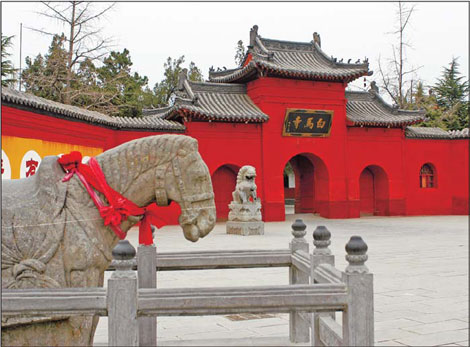
White Horse Temple
Introduction
The White Horse Temple, known as Baima Temple in Chinese, holds the distinction of being the first Buddhist temple established in China. Located in Luoyang, Henan province, this historic site is a cornerstone of Chinese Buddhism and a symbol of the cultural exchange between China and India. Constructed in AD 68 during the Eastern Han Dynasty (25–220), the temple was built to honor two Indian monks, Kasyapamatanga and Dharmaranya, who brought Buddhist scriptures and statues to China. The temple's name, "White Horse," commemorates the white horses that carried these sacred items.
Today, the White Horse Temple is not only a spiritual sanctuary but also a significant cultural and historical landmark. It attracts visitors from around the world who come to explore its ancient architecture, learn about its rich history, and experience its serene atmosphere. The temple continues to serve as a hub for Buddhist learning and cultural exchange, with monks studying and practicing their faith within its sacred grounds.
History
According to legend, Emperor Ming of the Eastern Han Dynasty (reign: AD 57–75) had a dream of a golden figure with a halo, which his advisors interpreted as the Buddha from India. In response, the emperor dispatched emissaries to learn more about Buddhism. After years of travel, the emissaries returned with two Indian monks, Kasyapamatanga and Dharmaranya, who brought with them Buddhist scriptures and statues on white horses. To honor their contributions, Emperor Ming ordered the construction of the White Horse Temple in AD 68.
The temple became a center for translating Buddhist texts into Chinese, with the two monks translating the "Sutra in Forty-two Sections" at the temple's Qingliang Terrace. Over the centuries, the temple has undergone numerous renovations and expansions, with little of its original structure surviving. Despite this, the White Horse Temple has retained its historical and spiritual significance, serving as a beacon of Buddhism in China.
Architecture
The White Horse Temple's architecture reflects a blend of traditional Chinese and Buddhist styles, symbolizing the cultural exchange between China and India. Originally established during the Eastern Han Dynasty, the White Horse Temple has been repeatedly rebuilt following periods of war and destruction. The extant structures primarily date from the Yuan, Ming, and Qing dynasties, showcasing architectural elements from these distinct historical periods. The temple complex is arranged along a central axis, with a series of halls, courtyards, and pavilions. Key structures include the Hall of Heavenly Kings, the Hall of the Great Buddha, and the Hall of Mahavira, each adorned with intricate carvings and statues.
One of the temple's distinctive features is the Indian Buddhist shrine, a gift from the Indian government, meticulously constructed from materials imported from India. Completed in 2010, it symbolizes the strong and lasting relationship between the two countries. Highlighting its international nature, the temple boasts a variety of Buddhist structures, each reflecting a distinct tradition. These include a Thai shrine (originally built in 1992 and expanded in 2015), a Cambodian shrine (built in 2014), and a Sri Lankan-style hall (construction began in 2016).
The temple grounds are meticulously maintained, with lush gardens and ancient trees creating a tranquil environment for visitors and monks alike. The architectural design and natural surroundings of the White Horse Temple offer a glimpse into the spiritual and artistic achievements of ancient China.
Cultural Significance
The White Horse Temple holds immense cultural and religious significance as the birthplace of Chinese Buddhism. It represents the introduction and dissemination of Buddhist teachings in China, which have profoundly influenced Chinese philosophy, art, and culture. The temple's role as a center for translating Buddhist scriptures into Chinese has been instrumental in shaping the development of Buddhism in the country.
In addition to its historical importance, the White Horse Temple continues to serve as a spiritual and cultural hub. Monks from around the world visit the temple to study and practice Buddhism, fostering international collaboration and understanding. The temple's efforts to establish itself as a leading center of Buddhism in Asia, including plans to expand its grounds and host shrines representing various Southeast Asian Buddhist traditions, further underscore its cultural significance.
Tourism
The White Horse Temple is a popular tourist destination, attracting visitors with its rich history, stunning architecture, and serene atmosphere. Situated in Luoyang, one of China's ancient capitals and a cradle of Chinese civilization, the temple is easily accessible by train, bus, or flight. Luoyang itself is home to three UNESCO World Heritage Sites, including the Longmen Grottoes.
Visitor Information
The White Horse Temple is open to visitors throughout the year, with operating hours typically from morning to evening. Visitors can explore the various halls, courtyards, and shrines, as well as enjoy the peaceful gardens and natural surroundings.
The best time to visit Luoyang and the White Horse Temple is during the spring months of March to May, when the weather is warm and the famous Peony Flower Festival takes place. The festival, held annually from April to early May, showcases the city's beautiful peony gardens in full bloom. Autumn, from September to November, is another pleasant time to visit, with comfortable temperatures ranging from 20 C to 22 C.
Festivals and Events
The White Horse Temple hosts various cultural and religious events throughout the year, attracting both devotees and tourists. The Peony Flower Festival in April is a major highlight, celebrating Luoyang's status as the "City of Peonies." During this time, the temple and the surrounding city come alive with vibrant displays of flowers, cultural performances, and traditional activities.
In addition to the Peony Flower Festival, the temple is a site for Buddhist ceremonies and rituals, where monks and devotees gather to chant sutras, light incense, and pray for good fortune. These events offer visitors a unique opportunity to experience the spiritual and cultural heritage of Chinese Buddhism.








